Everyday Lessons in Masonry • Lessons from the Trestle Board
Every Mason knows the trestle board as a symbol. But what happens when we begin using that idea to intentionally plan the life we are building?
Most brothers have never really looked at their trestle board.
That may sound like an odd statement. After all, every Mason has heard of the Trestle Board. We have listened to its explanation in our ritual. We understand what it represented to the operative workman.
But I am not talking about the Trestle Board in the Lodge.
I am talking about yours.
The one upon which the design of your life is being drawn.
And here is the question that has been bothering me lately:
What if your life needed a blueprint, not just a wish list?
Most of us have wishes.
We want to be better husbands, fathers, grandfathers, friends, and Brothers. We want to spend more time with God. We want to improve our health. We want to learn more. We want to help somebody. We want to call that Brother we have been thinking about.
Someday.
When things slow down.
When we have more time.
When circumstances are better.
But an operative Mason could not have built a great structure that way.
He could not arrive at the worksite each morning, pick up his tools and say, “Well, I hope we build something beautiful today.”
There had to be a design.
I understand that idea perhaps a little differently because of the work I do every day.
The Modern Trestle Board
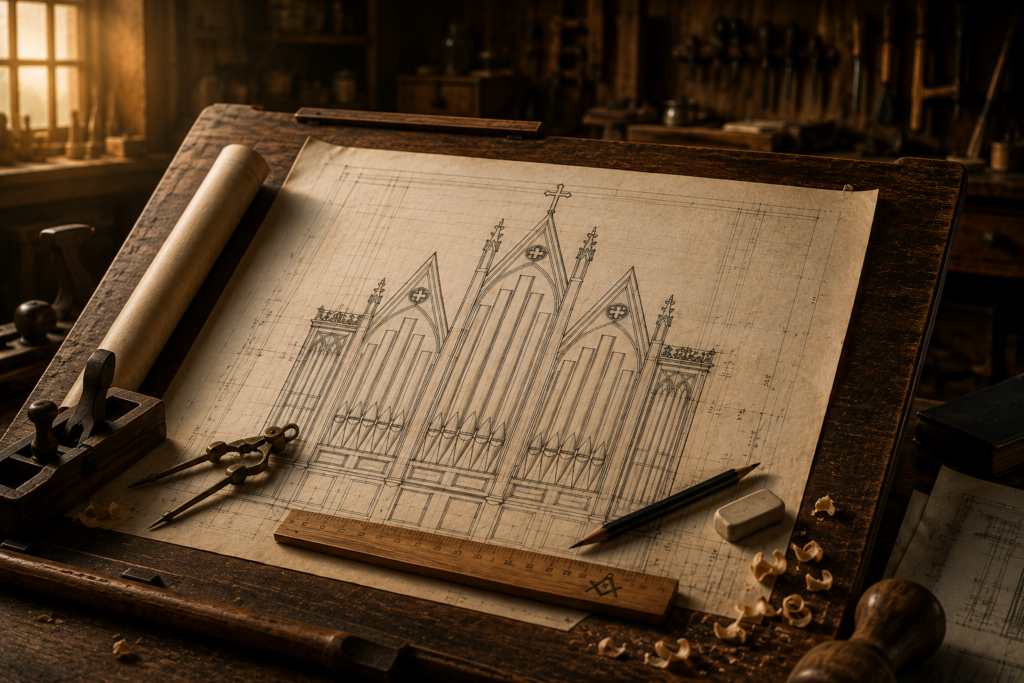
I am a pipe organ builder. More specifically, much of my work involves designing the visual appearance of a pipe organ and then preparing the detailed shop drawings that allow the craftsmen in our shop to actually build it.
Before a piece of wood is cut, before a façade pipe is placed, before a case begins taking shape in the shop, somebody has to determine what we are building.
I may begin with an architectural space, measurements, photographs, conversations, and perhaps a rough idea of what the finished organ should become.
Then comes the drawing.
The proportions have to work.
The pipes have to fit.
The case has to relate to the architecture of the church.
Individual pieces have to be dimensioned.
Connections have to be considered.
And eventually the concept becomes a set of drawings that another craftsman can place in front of him and use to do his part of the work.
In a very real sense, I work on a modern trestle board.
And here is what years of doing that kind of work have taught me:
The drawing is not the building. But the building rarely becomes what it ought to be without the drawing.
The craftsmen in our shop possess tremendous skill. Give them a proper design and they can turn drawings, dimensions, lumber, pipes, metal, and countless individual pieces into something magnificent.
But skill alone does not determine what gets built.
There must first be a design.
Our Masonic ritual tells us that the Trestle Board was where the Master workman drew his designs for the workmen to follow.
Then came the labor.
That distinction may be more important than we realize.
A Wish Is Not a Blueprint
A wish says, “I would like to become a better man.”
A blueprint asks, “What am I going to do today that makes me one?”
A wish says, “I need to spend more time with my family.”
A blueprint says, “Thursday evening belongs to them.”
A wish says, “I ought to check on Brother Jim.”
A blueprint says, “Call him before supper.”
A wish says, “I want to grow spiritually.”
A blueprint says, “Begin tomorrow morning with ten quiet minutes before the rest of the world gets my attention.”
Suddenly the idea becomes very Masonic.
Because Masonry has never been merely about possessing tools.
It is about using them.
We are given the Twenty-Four Inch Gauge, but we still have to decide how our time will be divided.
We are given the Common Gavel, but we still have to identify what rough edges need removing.
We are given the Plumb, Square, and Level, but we still have to compare our conduct against them.
And eventually we are reminded of the Trestle Board.
The design.
When the Trestle Board Is Blank
There is a remarkable moment in the Master Mason degree when the Craftsmen assemble for work and discover that the trestle board is blank.
There are no designs.
And because there are no designs, there is no work for them to perform.
Think about that for a moment.
The workmen are present.
The tools are present.
The ability is present.
The Temple is still there.
But without the design, the work stops.
That may describe more lives than we care to admit.
We are busy.
Very busy.
Our calendars are full. Our phones never stop. We go to work, answer messages, attend meetings, take care of the house, sit in Lodge, help our families, and somehow reach the end of another week wondering where it went.
We have been active.
But have we been building?
Those are not necessarily the same thing.
I see the difference in the shop.
A craftsman can be surrounded by some of the finest tools available. He can possess decades of experience. He can have beautiful material stacked beside his bench.
But before he begins, he still looks at the drawing.
Why?
Because activity without direction can produce a great deal of work without producing the thing we intended to build.
The same can be true of life.
A man can work hard for forty years and never stop to ask what all that labor is supposed to be constructing.
He can fill every day while leaving the larger design almost completely blank.
Maybe that is one of the quiet lessons of the Trestle Board.
Before deciding how hard we are going to work, perhaps we ought to decide what we are trying to build.
What Are You Building?
What kind of husband am I trying to become?
What kind of father?
What kind of Brother?
What kind of Mason?
What kind of man do I hope my grandchildren remember?
What habits would that man possess?
What would he stop doing?
What would he begin doing?
Who would he spend more time with?
Who would he forgive?
Who would he call?
Where would he place God in the design?
Those questions begin turning wishes into lines on a blueprint.
And perhaps the design does not need to be complicated.
What Part of the Work Belongs to Today?
When I prepare drawings for an organ, no one craftsman builds the entire instrument in one day. Each person has his portion of the work.
Life may be much the same.
We do not build the entire structure today.
We simply ask:
What part of the work belongs to today?
Maybe it is one act of kindness.
One Brother checked upon.
One thing learned.
One conversation we have been avoiding.
One hour used better than yesterday.
One rough edge knocked away.
One decision brought a little closer to the Square.
Small pieces of work, performed according to a design.
Day after day.
Stone after stone.
Or in my case at work, drawing after drawing and piece after piece.
Until eventually something begins to rise that once existed only as lines on a page.
There are moments in our shop when I can stand back and look at a completed pipe organ that began months or even years earlier as a drawing on my computer screen.
The drawing is gone.
In its place stands the thing we intended to build.
I wonder whether the same might someday be said of us.
Masonry has spent centuries placing the language of builders into our hands. Maybe we sometimes admire the symbolism so much that we forget the obvious lesson hidden inside it.
Builders build from plans.
So perhaps tonight, before asking yourself what you hope tomorrow will bring, ask something different:
What am I building?
Then take out a sheet of paper.
Draw a few lines.
Make a few decisions.
Give tomorrow’s Craftsman something to work from.
Because a good man may have many hopes for his life.
But a Mason ought to have a design.
Continue the Work
If this article gave you something to think about, there’s more waiting each week.
From the Trestle Board brings one thoughtful Masonic reflection each Sunday—practical lessons for carrying the Craft into everyday life.
Looking for something you can put into practice today?